Trees Removed Without Damage to Surrounding Property
Tree service in Greenville for mature hardwoods and pines standing close to homes, outbuildings, and property lines
MACK Land & Tree Management LLC handles tree removal in Greenville for property owners dealing with trees that have outgrown their space or created a risk to structures nearby. Many Upstate lots carry mature hardwoods and pines that were growing long before the homes beside them were built, and those trees rarely fall in a convenient direction. When a tree leans toward a roof, a driveway, or a shared property line, the removal has to be planned around what sits in the drop zone—not just the tree itself.
Every job at MACK Land & Tree Management LLC starts with a free estimate walk through the property alongside the owner, who reads the tree's lean, identifies what sits beneath it, and plans where debris will go before the crew begins cutting. Where space is tight—as it often is on older Greenville lots where pines have grown close to a workshop or fence line—the crew cuts the tree in sections and rigs limbs down in a controlled sequence rather than dropping them whole. All debris is hauled and cleared before the job is marked complete.
Schedule a property walk to identify which trees on your lot require removal and how the work would be sequenced.
How Tree Removal Is Sequenced When Space Is Limited
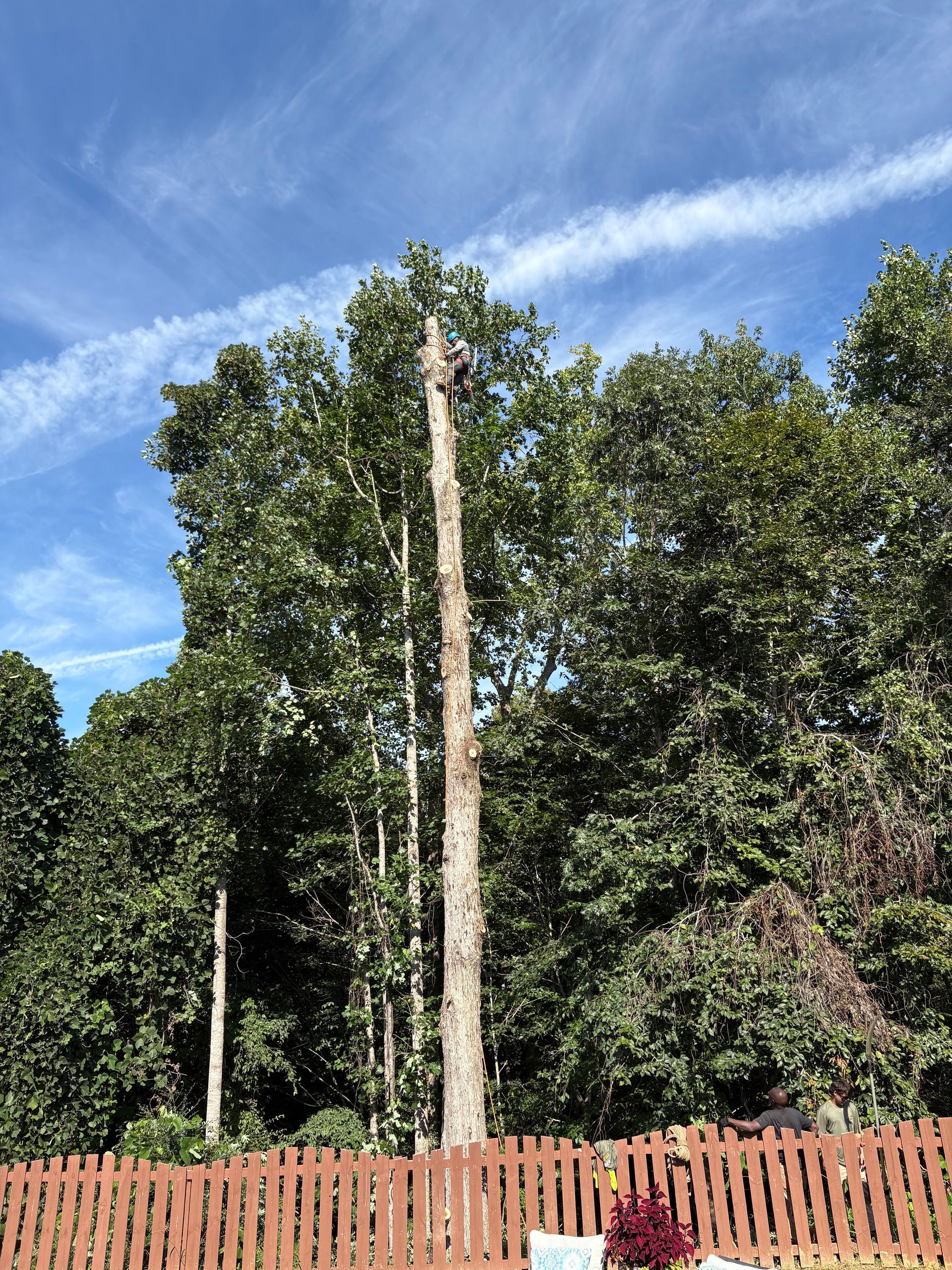
Sectional removal and rigging are not the same as a straightforward fell, and the distinction matters when a limb lands on a shingle roof or a parked vehicle if the cut goes wrong. Rigging involves attaching a line to a section before the cut is made, controlling the direction and speed of descent, and lowering it to a ground crew rather than letting it free-fall. That approach is standard on properties where the drop zone is obstructed by a building, a fence, or overhead lines—conditions that are common on the mature, densely planted lots found across older Greenville neighborhoods.
Once sectional cutting and rigging are complete, what you notice on the ground is a cleared space where the tree stood, with no ruts from dragged wood and no limb debris left against the structure the tree was near. The stump and root flare are visible and accessible, and the surrounding lawn and plantings remain undisturbed because the crew controlled where everything landed rather than letting it fall open.
The approach also accounts for what comes after the removal: if a stump grind is planned, the crew positions trunk sections and debris so the grinder can access the base without relocating material a second time. Properties where the tree was close to a foundation or walkway may require hand-moving debris in stages rather than dragging it across a surface that could be damaged, and that sequencing is decided during the estimate walk, not improvised on the day of the job.
What Property Owners Ask About Tree Removal
The questions below address how tree removal is actually performed, including how the crew makes decisions on tight lots and what the property looks like once the work is finished.
What determines whether a tree needs to be sectioned rather than felled in one cut?
The decision comes down to what sits within the fall radius—if a structure, vehicle, fence, or overhead line occupies that zone, the tree is sectioned from the top down and rigged in controlled pieces rather than dropped whole, regardless of tree size.
How does the crew protect a driveway or lawn during removal?
Limbs and trunk sections are rigged or hand-carried to a staging area rather than dragged across the surface, and larger pieces are cut to a manageable size before moving so concentrated weight does not damage pavers or turf.
What happens to the debris once the tree is down?
MACK Land & Tree Management LLC hauls and clears all debris—limbs, trunk sections, and wood chips—before the crew leaves, so the site is clean rather than piled for the property owner to manage later.
How does a tree's lean affect the removal plan?
Lean direction is read during the estimate walk and is one of the primary factors in choosing whether to rig sections, use a notch and back-cut to direct the fall, or cut from a position in the tree rather than from the ground; a tree leaning toward a structure almost always requires rigging.
Why does the estimate walk matter for properties in Greenville where lots have older hardwoods close to the house?
On established lots throughout Greenville, oaks and pines often have canopies that extend over rooflines, outbuildings, or neighboring property, and the estimate walk is where the crew maps each drop zone and identifies whether a limb has to come down in sections before the main trunk can be addressed—skipping that step leads to cut decisions made under pressure rather than in advance.
MACK Land & Tree Management LLC also performs tree service in Greer, Simpsonville, Taylors, Easley, and Spartanburg. To get started, call (864) 982-8249 to arrange a free walk through and review which trees on your property need to come down and how the removal would be approached.