Limbs Cut Correctly to Protect the Tree Long-Term
Tree pruning in Greenville for overhanging limbs, deadwood, and weak branch unions that have developed over years of unchecked growth
Flush-cut limbs and stub cuts are two of the most common errors made when trees are trimmed without arboricultural knowledge behind the work, and both cause problems that show up months or years after the job is done. The correct cut is made just outside the branch collar—the raised tissue where the limb meets the parent wood—because that collar contains the cells the tree uses to seal the wound and prevent decay from entering. MACK Land & Tree Management LLC starts every pruning job with a free estimate walk through the property, where the crew identifies deadwood, crossing limbs, and weak unions before any cuts are planned.
After the estimate walk, the crew works through the canopy in a deliberate order: deadwood comes out first because it is already a hazard, then crossing or rubbing limbs that create open wounds where bark wears away, then any growth that has extended toward the house, roof, or power line beyond a safe clearance. Cuts are made with the branch collar preserved, branches and clippings are hauled off before the job closes, and the customer is on site throughout so any questions about what is being removed and why can be answered in real time.
Arrange an estimate walk to review which limbs on your trees need to come out and how the pruning would be sequenced.
What Pruning Actually Accomplishes Versus What It Does Not
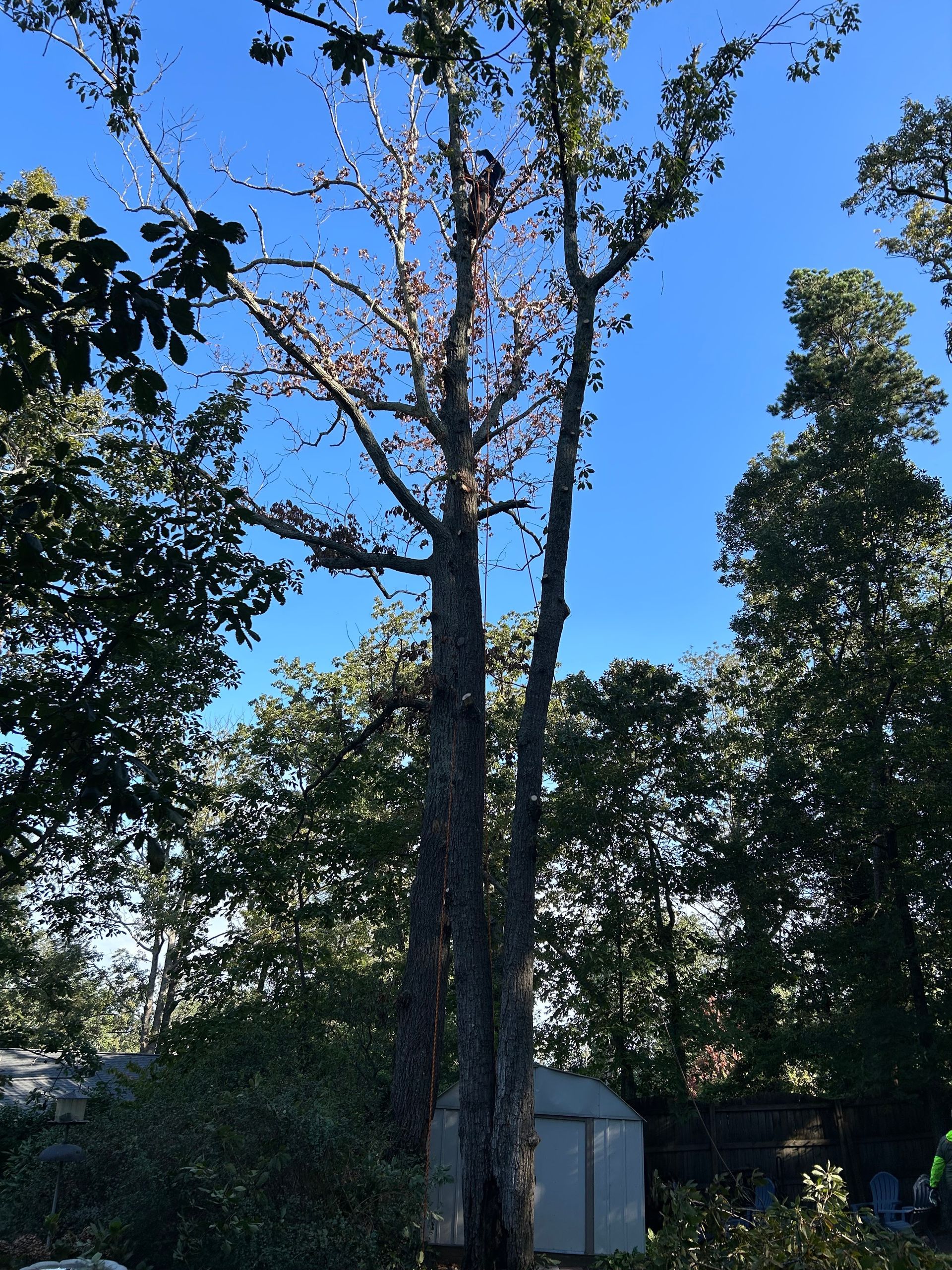
Pruning does specific, mechanical things: it removes mass from areas of the canopy where that mass creates risk, it eliminates entry points for fungal decay by correcting wound placement, and it adjusts canopy structure so future growth is better distributed. What it does not do is stop a tree from growing—poorly timed or incorrectly placed cuts can actually accelerate lateral growth by removing the apical dominance that keeps a canopy extending upward rather than outward toward a structure. That distinction matters when the goal is clearing roof clearance on a mature oak in a Simpsonville or Mauldin subdivision, where the tree has been growing toward the house for decades.
After MACK Land & Tree Management LLC completes a pruning job, you notice the clearance between the canopy and the roofline, fence, or power line immediately—the limb that was resting on the shingles or brushing the fascia is gone. You also notice the cleanup: no clippings left in the bed or on the lawn, no brush pile at the curb for the property owner to deal with later.
The number of cuts made and the parts of the canopy worked affect how long the pruning holds before growth reclaims the cleared space. A heavy reduction of live wood prompts more vigorous regrowth than a lighter structural trim does, and the crew factors that in when discussing the scope of the work during the estimate walk—removing everything that overhangs the roof in one pass may be less sustainable than a phased approach depending on the tree's vigor and species.
Common Questions About This Service
The questions below focus on how pruning decisions are made, what the correct cuts look like, and what the property shows once the work is finished.
What is a branch collar and why does it determine where the cut is placed?
The branch collar is the swollen ring of tissue at the base of a limb where it joins the trunk or a larger branch; cutting just outside that collar preserves the cells the tree uses to grow callus tissue over the wound, while cutting through or inside the collar removes that protective layer and leaves the wood exposed to decay.
How does the crew identify which limbs to remove before starting?
During the estimate walk, the crew looks for four conditions: deadwood that is already detached or dying, crossing limbs that abrade each other and create open bark wounds, co-dominant stems with included bark at the union that signal a structural weak point, and live growth that has extended into the clearance zone around the roof, driveway, or utility lines.
Why does the order in which limbs are removed matter?
Deadwood and structurally compromised limbs come out first because they represent immediate risk; removing them before working on the live canopy also changes how the tree's weight is distributed, which affects how much stress remains in the limbs that are pruned afterward.
What does finished pruning look like on an oak or pine that has been overhanging a roof on an established Greenville lot?
You see clean cuts with the collar ring intact rather than flush cuts or stubs, a defined clearance between the canopy edge and the roofline, and no torn bark on the trunk where limbs were removed—torn bark indicates the limb was dropped rather than cut in sections with a relief cut made first to prevent the weight from stripping bark as it fell.
How long does roof clearance typically hold after a pruning?
Clearance longevity depends on species and the tree's growth rate—fast-growing species like water oaks may reclaim several feet of vertical growth in two to three growing seasons, while slower-growing hardwoods hold clearance longer; the scope and approach discussed during the estimate walk are the right place to address that question for your specific tree.
MACK Land & Tree Management LLC also performs
tree pruning in Greer, Simpsonville, Taylors, Easley, and Spartanburg. Call (864) 982-8249 to set up a free estimate walk and discuss which limbs need attention and how the work would be carried out on your property.